Cooking Skills Every Man Should Have by 30: The 5 Core Meals
Relying on takeout is an expensive, unhealthy habit. By age 30, you need to master the kitchen. Here are the five foundational meals every man must know how to cook with his eyes closed to save money and fuel elite performance.
The Harsh Reality of the Delivery Diet
If you are approaching 30 and still relying on a teenager on a bicycle to deliver your dinner at a 90% markup, you are failing a basic test of adulthood. Let’s get one thing straight: cooking is not a hobby. It is not something reserved for culinary enthusiasts or reality television. It is a foundational survival skill. It dictates your physical performance, your financial trajectory, and your level of self-reliance.
According to financial research, the average American spends over $3,000 a year on dining out and delivery. On top of the financial drain, restaurant meals contain significantly higher levels of sodium, inflammatory seed oils, and hidden sugars than food prepared at home. When you outsource your nutrition, you surrender control over what builds your body.
If you want to control your physique, your bank account, and your overall standard of living, you must control your kitchen. You don't need to be a Michelin-starred chef. You don't need a pantry full of obscure, expensive ingredients. You simply need a reliable, repeatable system.
You need an arsenal of meals you can execute with your eyes closed. Here are the five foundational meals every man must master by age 30, the exact protocols to make them, and the rules of engagement for the kitchen.
1. The Benchmark Steak: Mastering Heat and Meat
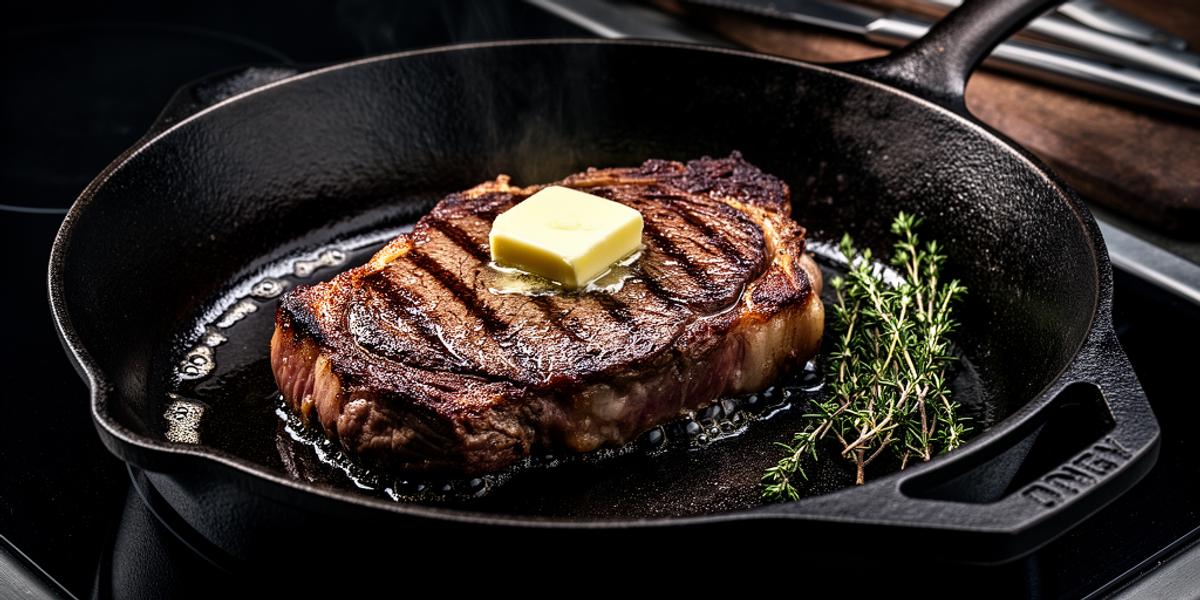
Every man needs to know how to cook a steak indoors. It’s the ultimate metric of basic culinary competence. A perfectly cooked steak requires an understanding of the Maillard reaction—the chemical process that gives browned food its distinctive flavor—and basic temperature control.
Stop buying thin, cheap cuts that curl up in the pan. Buy a thick-cut (at least 1.5 inches) Ribeye or New York Strip.
The Protocol:
- Dry Brine: Salt the steak aggressively on all sides at least 45 minutes before cooking (or leave it uncovered in the fridge overnight). This draws moisture out, dissolves the salt, and pulls it back into the meat, seasoning it to the core and drying the surface for a better crust.
- The Sear: Place a cast-iron skillet over high heat until it is smoking hot. Add a high-smoke-point oil (like avocado oil or beef tallow).
- The Flip: Lay the steak in the pan away from you so the oil doesn't splash. Sear for 2 minutes per side to build a crust.
- The Baste: Drop the heat to medium-low. Toss in a tablespoon of butter, two smashed garlic cloves, and a sprig of rosemary. Tilt the pan and use a spoon to quickly baste the foaming butter over the steak for 1 minute.
- The Temperature: Use an instant-read meat thermometer. Pull the steak at 130°F for medium-rare or 140°F for medium.
- The Rest: Place the steak on a cutting board and leave it alone for 10 minutes. If you cut it immediately, the un-coagulated juices will bleed out, leaving you with dry meat.
2. The Infinite Stir-Fry: The Fridge Clearer
The stir-fry is a high-leverage meal. It is the most efficient way to turn leftover vegetables, a random protein, and 15 minutes of your time into a nutrient-dense dinner. It teaches you mise en place—the culinary term for having all your ingredients prepped and organized before the heat turns on. Once a stir-fry starts, you do not have time to chop.
The Protocol:
- The Ratio: Aim for 1 pound of protein (chicken breast, flank steak, or shrimp) to 1 pound of chopped vegetables (broccoli, bell peppers, snap peas).
- The Prep: Slice the meat against the grain into thin, uniform strips. Mince three cloves of garlic and a thumb-sized piece of ginger.
- The Sauce: Keep it simple. In a bowl, mix 3 tablespoons of soy sauce, 1 tablespoon of oyster sauce, 1 tablespoon of rice vinegar, and a dash of sesame oil.
- The Execution: Get a large skillet or wok screaming hot. Add oil. Cook the meat in a single layer until just browned (about 3 minutes). Remove the meat from the pan.
- The Veggies: Add a little more oil, toss in the vegetables, and stir constantly for 3-4 minutes until they are vibrant but still have a crunch. Create a hole in the center, drop in the garlic and ginger, and cook for 30 seconds until fragrant.
- The Finish: Add the meat back in, pour the sauce over everything, and toss for 1 minute until the sauce thickens and coats the food. Serve over rice.
3. The Sheet Pan Chicken: The Time Multiplier
If you are serious about your fitness and your time, meal prep is non-negotiable. The sheet pan chicken meal is the king of low-effort, high-yield cooking. It teaches you how to utilize your oven's passive cooking power, allowing you to produce three to four days of high-protein lunches in under 45 minutes, with only one pan to clean.
The Protocol:
- The Hardware: You need a heavy-duty, rimmed baking sheet (half-sheet pan) and aluminum foil or parchment paper for effortless cleanup.
- The Protein: Use boneless, skinless chicken thighs. They are cheaper, more flavorful, and significantly more forgiving than chicken breasts, which dry out quickly.
- The Setup: Preheat your oven to 400°F. Space is your friend here. If you crowd the pan, the food will steam instead of roast.
- The Seasoning: Place 1.5 lbs of chicken thighs, 2 cups of broccoli florets, and 2 cups of diced sweet potatoes on the pan. Drizzle generously with olive oil. Season aggressively with kosher salt, black pepper, smoked paprika, and garlic powder. Use your hands to toss everything until evenly coated.
- The Cook: Roast for 30-35 minutes. You are looking for an internal temperature of 165°F in the chicken and a caramelized, slightly charred edge on the sweet potatoes.
4. The Bulletproof Chili: The Batch Cooker
Chili is the ultimate utility meal. It is cheap, packed with protein and fiber, scales infinitely, and actually tastes better on the second and third day as the flavors meld. Master a basic chili, and you have an insurance policy in your freezer against lazy evenings and delivery apps. At roughly $2.50 to $3.00 per serving, it is a masterclass in culinary economics.
The Protocol:
- The Base: Heat a large heavy-bottomed pot or Dutch oven over medium-high heat. Add 1 tablespoon of olive oil and 1.5 lbs of ground beef (80/20 lean-to-fat ratio). Break it apart and let it brown completely. Do not stir it constantly; let it sit to develop a crust.
- The Aromatics: Drain excess fat if necessary, leaving about two tablespoons. Add one large diced yellow onion and cook for 5 minutes until soft. Add four minced garlic cloves and cook for 1 minute.
- The Spices: This is where the magic happens. Add 2 tablespoons of chili powder, 1 tablespoon of ground cumin, 1 teaspoon of smoked paprika, and 1 teaspoon of oregano. Stir into the meat and onions for 60 seconds to toast the spices.
- The Liquids: Pour in one 28-ounce can of crushed tomatoes and one cup of beef broth. Use a wooden spoon to scrape up the browned bits (the fond) from the bottom of the pot.
- The Beans: Drain and rinse one can of kidney beans and one can of black beans. Add them to the pot.
- The Simmer: Bring to a boil, then immediately reduce the heat to low. Cover and simmer for at least 45 minutes (up to 2 hours). Taste and aggressively adjust the salt before serving.
5. Eggs Any Way: The Morning Standard
Eggs are the foundation of culinary technique. They are cheap, nutrient-dense, and highly sensitive to temperature. If you can control a pan well enough to cook eggs perfectly, you can cook almost anything. You need to know how to scramble them without turning them into rubber, and how to fry them without breaking the yolk.
The Protocol for Scrambled:
- Low and Slow: High heat ruins scrambled eggs. Crack three eggs into a bowl, season with salt, and beat vigorously until the yolks and whites are completely homogenous.
- The Pan: Place a non-stick skillet over medium-low heat. Melt a knob of butter.
- The Curd: Pour the eggs in. Let them sit for 15 seconds, then use a silicone spatula to gently push the eggs from the edge of the pan to the center, creating large, soft curds.
- The Pull: Take the pan off the heat before the eggs look completely done. They will continue to cook from the residual heat of the pan. They should be slightly glossy, not dry and brown.
The Protocol for Fried (Sunny-Side Up):
- Medium Heat: Heat a skillet over medium heat with a tablespoon of olive oil or butter.
- The Crack: Crack the egg gently into a small bowl first, then slide it into the pan to prevent broken yolks and shell fragments.
- The Baste: Cook until the whites are mostly set. To cook the thin layer of white over the yolk without flipping, tilt the pan slightly and use a spoon to baste the hot oil over the egg whites until they turn opaque.
The Mandatory Hardware
You do not need a 15-piece knife block or a $500 set of copper pans. In fact, buying cheap sets is a trap. Buy individual, high-quality tools that will last a decade. You only need three things to execute all five of these meals at an elite level:
- An 8-Inch Chef’s Knife: This is an extension of your arm. Do not use dull steak knives to chop onions. A Victorinox Fibrox 8-inch knife costs about $40 and performs like a $150 blade. Keep it sharp.
- A 12-Inch Cast-Iron Skillet: It holds heat better than anything else, making it mandatory for searing steaks, frying eggs, and building chili. A standard Lodge cast-iron skillet costs $30. It will literally outlive you if you don't rust it out.
- An Instant-Read Meat Thermometer: Stop guessing if your chicken is raw or your steak is ruined. Cooking meat is a matter of thermodynamics, not intuition. Spend $30 on a ThermoPop or a similar fast-reading digital thermometer.
The Challenge
Knowledge without execution is just trivia. Reading an article about cooking does not make you a cook.
Here is your challenge: Pick one of these five meals today. Go to the grocery store, buy the exact ingredients, and cook it tonight. Follow the protocol exactly. Pay attention to the heat, the sounds, and the timing.
When you master these five meals, you eliminate the excuse of "having nothing to eat." You take back your time, your health, and your money. Stop outsourcing your survival. Step up to the stove and do the work.

Alex Rivera
Sports Nutritionist, CSCS
Certified sports nutritionist who cuts through supplement BS and diet fads. Alex writes about real food for real performance — no gimmicks.
View full profile →