The Day After Zero: How to Recover a Broken Streak Without Quitting
You broke your streak. The counter is at zero. Here is the exact psychological framework and step-by-step protocol to stop the 'what the hell' effect, reframe your failure, and get back on track today. No guilt, just data and execution.

You blew it. You had a solid run going—maybe 14 days, maybe 60. You were hitting the gym, staying off the junk food, waking up early, or keeping your head down in deep work. Then yesterday happened. You caved. You hit snooze. You ate the garbage. You skipped the reps. You broke the streak.
Now you’re staring at a counter that says "Day 0." The immediate, overwhelming impulse is to burn the whole operation to the ground. You think, "I ruined it. The momentum is gone. I might as well take the rest of the week off and start fresh on Monday."
Stop right there. That exact thought pattern is the dividing line between men who actually forge ironclad discipline and guys who perpetually ride the self-improvement carousel, starting over every single month.
The streak is a tool. It is a psychological lever to get you moving. But when a tool breaks, you don’t abandon the construction site. You fix the tool, you adjust your grip, and you get back to work. Here is exactly how to recover after breaking a streak, why one bad day doesn't erase fifteen good ones, and the protocol to ensure yesterday's slip doesn't become today's collapse.
The "What The Hell" Effect
In psychology, there is a well-documented phenomenon known as the Abstinence Violation Effect (AVE). In plain English, it’s the "What the Hell" effect.
Researchers studying addiction and behavioral changes noticed a pattern: when someone who has committed to strict abstinence (whether from alcohol, sugar, or skipping workouts) has a minor slip, they experience a massive spike of cognitive dissonance and guilt. They feel like a hypocrite. To resolve this uncomfortable feeling, the brain throws its hands up and says, "What the hell, the seal is broken, I might as well go all out."
A guy misses his morning workout, so he decides to eat a sleeve of Oreos at midnight. Why? Because the perfect streak is dead, so the day is "ruined."
This is a catastrophic miscalculation of how progress works.
If you successfully executed your habit for 15 days and missed day 16, your brain is telling you that you are back at square one. The math tells a different story. You have a 93.7% success rate. If you scored a 93.7% on a final exam, you’d get an A. You wouldn’t tear up the test and drop out of college.
Your body and your brain do not operate on a binary "perfect or worthless" scale. The neural pathways you’ve been building over the last 15 days did not evaporate because you slept in once. The muscle mass didn't melt. The discipline isn't gone. It just took a hit. Treat a slip like a flat tire. You don't slash the other three tires because one went flat. You patch it and keep driving.
The Neuroscience of the Slip
To fix the problem, you need to understand why it happened. No emotion, no self-pity—just data.
Your brain operates using two primary systems for action: the prefrontal cortex and the basal ganglia. The prefrontal cortex is your executive command center. It handles willpower, long-term planning, and new habit formation. It requires a massive amount of energy to run.
The basal ganglia is the brain's autopilot. It stores your old, deeply ingrained habits. It runs on almost zero energy.
When you are building a new streak, you are forcing the prefrontal cortex to override the basal ganglia. But what happens when you get a terrible night of sleep? Or your boss hands you a high-stress project? Or you get into an argument with your partner?
Your cognitive load maxes out. Your prefrontal cortex gets fatigued and goes offline. When that happens, your brain defaults to the basal ganglia to save energy. You revert to your oldest, easiest habits. You skip the gym. You order the pizza. You doomscroll.
Understanding this is crucial because it removes the moral judgment from the failure. You didn't fail because you are inherently weak or fundamentally flawed. You failed because your system was stressed, and your new habit wasn't ingrained deeply enough to survive on autopilot yet.
The Metric Shift: Win Rates Over Streaks
Streaks are incredibly motivating in the beginning. Gamifying your life with a daily counter is a great way to manufacture early momentum. But over a long enough timeline, streaks become fragile. Life is chaotic. Eventually, a flight gets delayed, you get sick, or an emergency demands your attention, and the streak will break.
If your entire identity is tied to an unbroken chain of days, a single break destroys your identity.
Serious men transition from tracking "streaks" to tracking "win rates."
Instead of looking at how many consecutive days you can string together, look at a 30-day rolling window. Your goal is not perfection; your goal is an elite win rate.
Let’s say you want to work out 5 days a week. Over a 30-day month, that’s roughly 21 workouts. If you hit 19 out of 21, your win rate is 90%. That is an elite performance.
Professional baseball players fail to hit the ball 70% of the time and get inducted into the Hall of Fame. Tom Brady’s career completion percentage is 64.3%. He didn't retire because he threw an incomplete pass on a Tuesday.
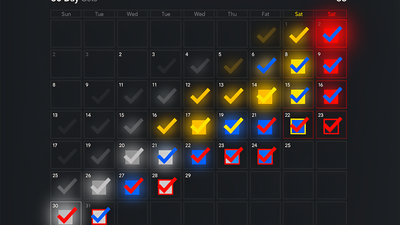
Start tracking your habits on a spreadsheet or a physical calendar using green and red markers. When you see a sea of green with one or two red marks, your brain stops panicking. The visual evidence proves that the red mark is an anomaly, not the rule.
The "Never Miss Twice" Rule
You cannot change the fact that you missed yesterday. That data point is locked in. But you have absolute, tyrannical control over what happens today.
This brings us to the cardinal rule of habit recovery, popularized by author James Clear: Never miss twice.
Missing one day is a slip. Missing two days is the beginning of a new habit.
When you miss a day, the compounding interest of your progress takes a microscopic hit. If you get right back on the horse the next day, the trajectory remains largely unchanged. But if you miss two days, the curve flattens. If you miss three, it begins to reverse.
The second day is the most dangerous day in the lifecycle of a habit. The friction to restart is incredibly high because you are battling both the physical inertia of stopping and the psychological weight of guilt.
Make this a non-negotiable law in your life. You are allowed to get sick. You are allowed to have an off day. But you are never, under any circumstances, allowed to miss two days in a row. If yesterday was a zero, today must be a one. Period.
The Trap of Overcompensation
When high-achieving men break a streak, their first instinct is often to punish themselves through overcompensation.
If they missed a 45-minute workout on Wednesday, they try to do a grueling two-hour workout on Thursday. If they broke their diet by eating 1,000 extra calories yesterday, they try to fast completely today.
Do not do this. Overcompensation is a trap.
When you overcompensate, you spike the friction of the habit to an unsustainable level. You are already dealing with the mental resistance of restarting; adding a punishment on top of it almost guarantees a second failure. If you try to fast all day to make up for yesterday's binge, by 8 PM you will be ravenous, your willpower will crack, and you will binge again. Now you’ve missed twice.
The goal of the day after a failure is not to make up for lost time. The goal is simply to re-establish the baseline.
If your baseline is a 45-minute workout, do exactly 45 minutes today. If your baseline is reading 10 pages, read exactly 10 pages. Do not try to be a hero. Be a professional. Professionals don't operate in wild swings of extreme effort and extreme apathy. They show up, punch the clock, hit the baseline, and move on.
The 24-Hour Recovery Protocol
You are at Day 0. Here is your exact, step-by-step protocol for the next 24 hours to get your momentum back.
Step 1: The Autopsy (Data, Not Drama)
Sit down with a pen and paper. Write down exactly why you missed yesterday. Trace the failure back to its root cause.
Did you miss your morning run? Yes. Why? Because you hit snooze. Why? Because you were exhausted. Why? Because you went to bed at 1 AM. Why? Because you were scrolling on your phone.
The root cause wasn't a lack of willpower at 6 AM. It was a lack of boundaries at midnight. Fix the root cause. Tonight, the phone goes in another room at 10 PM.
Step 2: The Micro-Commitment
If the resistance to starting again feels overwhelming, lower the barrier to entry. Shrink the habit down to a micro-commitment. If the thought of a heavy gym session makes you want to quit, commit to just putting on your gym clothes and driving to the parking lot. Tell yourself you can leave after 5 minutes if you want to. Once you are there, momentum takes over. Prove to your brain that you are still the guy who shows up.
Step 3: Hydrate, Fuel, and Sleep
A broken streak is often the result of physiological burnout. Your willpower is a battery. If you are dehydrated, running on 5 hours of sleep, and eating garbage, your battery is dead. Spend the next 24 hours aggressively recovering your physiology. Drink a gallon of water. Eat a high-protein, whole-food meal. Get 8 hours of sleep tonight. Rebuild the foundation so your prefrontal cortex has the energy to do its job tomorrow.
Step 4: Verbalize the Return
Look in the mirror or write it down in a journal: "Yesterday was a slip. Today, I am back on the program." It sounds overly simple, but verbalizing your commitment interrupts the subconscious "What the Hell" loop playing in your head. It draws a line in the sand.
The Challenge
You are reading this because you missed. You stumbled. Good. Welcome to the real world, where perfection is a myth and resilience is the only currency that matters.
Anyone can hold a streak together when the weather is nice, motivation is high, and life is easy. The men who actually achieve greatness are the ones who know how to take a punch, face-plant into the dirt, and stand back up the very next day without throwing a pity party.
Your challenge is right in front of you. You have a choice to make today. You can let yesterday's failure dictate today's actions, or you can draw a line in the sand.
Execute the autopsy. Find the root cause. Lower the friction. Re-establish the baseline.
Do not miss twice. Get back to work today.

Marcus Reid
Discipline Coach & Former Army Ranger
Former Army Ranger turned discipline coach. Marcus writes about mental toughness, habit systems, and building the kind of resilience that doesn't break under pressure.
View full profile →