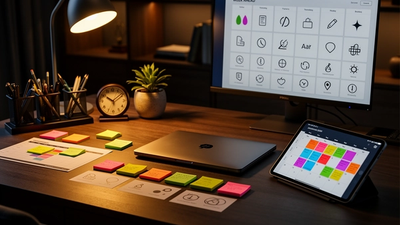
Deep Work Protocol: How to Focus for 4 Hours When Your Brain Wants to Scroll
Your inability to focus isn't a personality flaw; it's a conditioning problem. Learn how to apply Cal Newport's deep work principles to rebuild your attention span, eliminate digital noise, and unlock your ultimate competitive advantage.
Most men operate at a fraction of their cognitive capacity. They mistake being busy for being productive, spending eight hours a day in a state of frantic shallow work—answering emails, checking Slack, and scrolling social media, all while convincing themselves they are getting things done.
They aren't.
In a distraction-heavy economy, the ability to perform deep work is the ultimate competitive advantage. Coined by computer science professor Cal Newport, "Deep Work" refers to professional activities performed in a state of distraction-free concentration that push your cognitive capabilities to their limit.
Deep work creates new value, improves your skills, and is hard to replicate. Shallow work—the logistical, easily distracted tasks—prevents you from getting fired, but deep work is what gets you promoted, builds businesses, and creates lasting wealth.
If you want to separate yourself from the pack, you don't need to work longer hours. You need to learn how to sit down and focus intensely for four hours. Here is the exact protocol to achieve that when your brain is screaming at you to check your phone.
The Biology of Distraction: Why You're Failing to Focus
Stop blaming your lack of focus on a lack of willpower. Your inability to concentrate is a biological and structural problem.
Every time you check your phone, open a new tab, or respond to a notification, your brain receives a micro-dose of dopamine. Over time, you have conditioned your brain to expect a reward every three to five minutes. When you sit down to do deep work—which is inherently difficult and doesn't offer immediate gratification—your dopamine-starved brain panics. It looks for an escape route.
Furthermore, research by Dr. Gloria Mark at UC Irvine shows that it takes an average of 23 minutes and 15 seconds to return to your original level of focus after an interruption. If you check your phone three times an hour, you are perpetually operating in a state of "attention residue." You are never actually focused; you are just skimming the surface of your cognitive ability.
When you first sit down to work, you will experience what neuroscientist Dr. Andrew Huberman calls "limbic friction." This is the internal resistance you feel when transitioning from a state of low effort (scrolling) to high effort (deep work).
The rule is simple: Expect the first 20 minutes to suck. Your brain will actively fight you. It will remind you of an email you forgot to send. It will tell you to check the news. Recognize this friction not as a sign that you can't focus, but as the biological toll you must pay to enter a state of flow. Push through the 20-minute barrier, and the friction will dissipate.
The Architecture of a 4-Hour Focus Block
You do not sit down and stare at a screen for four hours straight. That is not deep work; that is a marathon of diminishing returns.
Human attention is governed by ultradian rhythms—biological cycles that last approximately 90 minutes. Your brain can maintain peak cognitive output for about an hour and a half before it requires a period of rest and consolidation. To achieve four hours of deep work, you must build your schedule around these natural rhythms.
The 90-20-90 Protocol
To hit four hours of effective deep work, structure your session like this:
- Block 1: 90 minutes of intense, uninterrupted focus.
- Active Recovery: 20 to 30 minutes of decompression.
- Block 2: 90 minutes of intense, uninterrupted focus.
This gives you three hours of peak output. As you build your mental endurance, you can add a third 60-minute block, but for now, two 90-minute blocks will yield more high-quality output than eight hours of fragmented, shallow work.
The Rules of Active Recovery
The 20-minute break is where most men fail. They finish their first 90-minute block, feel a sense of accomplishment, and reward themselves by checking their phone or opening YouTube.
Do not do this. Introducing highly stimulating digital input during your break destroys your focus for the next block. It resets your dopamine baseline and floods your working memory with irrelevant information.
Your break must be low-stimulus. Walk outside. Stare at a wall. Do a 10-minute Non-Sleep Deep Rest (NSDR) protocol. Drink a glass of water. Let your brain process the information from the first block. Keep your phone in airplane mode.
Ruthless Environmental Design
Willpower is for amateurs. Professionals use environmental design. If you have to use willpower to resist checking your phone, you have already lost the battle. You must design an environment where distraction is physically impossible or highly inconvenient.
1. The Phone Ban
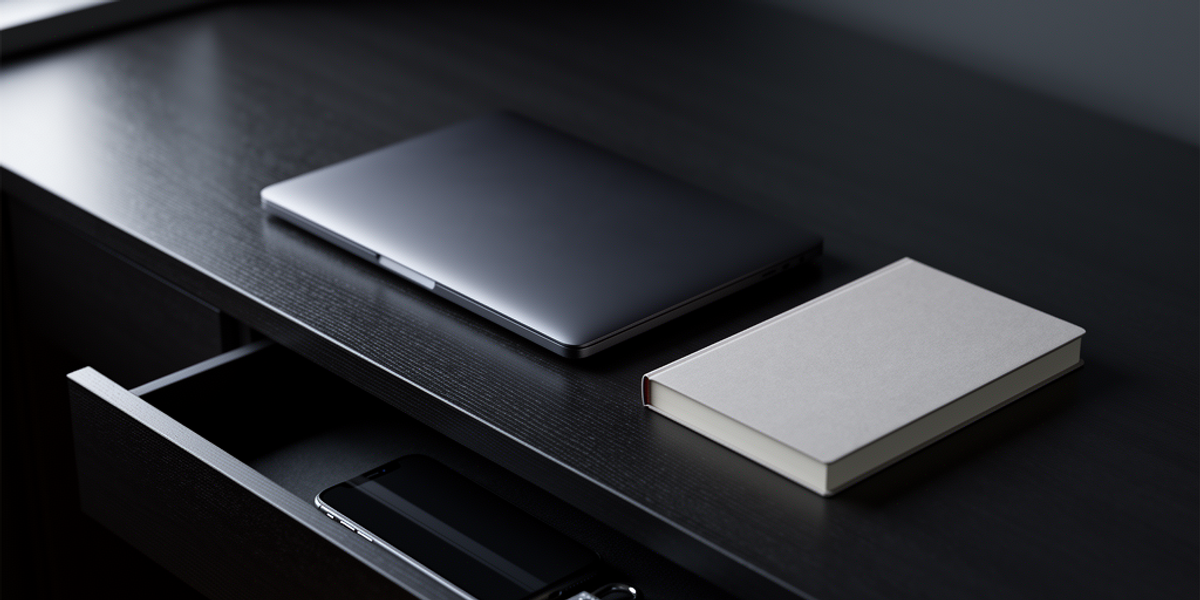
Putting your phone face down on your desk is useless. Research indicates that the mere presence of a smartphone on your desk—even if it is powered off—reduces cognitive capacity. Put your phone in another room. If you are working in an office, put it in your bag, zip the bag, and put the bag in a drawer.
2. Digital Quarantine
Your computer is a deep work machine, but it is also an arcade. You must forcefully disable the arcade.
- Use a site blocker: Install Freedom or Cold Turkey. Block all social media, news sites, and email clients for the duration of your deep work block. Make it impossible to open a distracting tab, even if you want to.
- Single-monitor setup: Multiple monitors encourage multitasking. Multitasking is a myth; it is actually rapid task-switching, which drains cognitive fuel. Use one screen. Maximize the window of the application you are using. Hide the dock or taskbar.
- Kill notifications: Turn on "Do Not Disturb" on your operating system. Close Slack. Close Outlook. If someone urgently needs you, they will call you. (And since your phone is in another room, they will have to wait 90 minutes. The world will not end).
Progressive Overload for Your Brain
Attention is a muscle. If you have spent the last five years living in a state of chronic digital distraction, you cannot expect to execute a perfect four-hour deep work block tomorrow. If you try, you will fail, get frustrated, and quit.
You must use the principle of progressive overload, exactly as you would in the gym. You start with a manageable weight and increase the load over time.
The 4-Week Ramp-Up Plan
- Week 1 (The Baseline): One 45-minute block per day. Focus purely on eliminating all distractions. No phone, no tabs, no exceptions.
- Week 2 (The Stretch): One 90-minute block per day. You will hit a wall around the 60-minute mark. Push through it. Embrace the boredom.
- Week 3 (The Double): Two 60-minute blocks with a 20-minute low-stimulus break in between.
- Week 4 (The Standard): The full 90-20-90 protocol.
Do not rush this process. Rebuilding your attention span takes time.
The Pre-Flight Ritual
Your brain relies on cues to understand what behavior is expected. If you work, eat, watch Netflix, and scroll social media at the same desk, your brain has no idea what state to enter when you sit down.
You need a pre-flight ritual—a specific sequence of actions that tells your nervous system it is time to do deep work.
1. Define the Singular Outcome
Never sit down to a deep work block and ask, "What should I work on?" Decision fatigue will kill your focus before you even start. The night before, write down the exact, singular outcome you want to achieve during your deep work block.
Bad: "Work on the marketing project." Good: "Write the first draft of the Q3 marketing report, covering sections one through three."
2. Clear the Physical Space
A cluttered desk represents unmade decisions. Clear your workspace. You should have nothing in front of you except your computer, a notebook, a pen, and a beverage.
3. Auditory Cues
Use sound to trigger focus. Many men find success with specific, repetitive audio that lacks lyrics, which can interfere with the language-processing centers of the brain. Binaural beats, brainwave music, or even the sound of brown noise can act as an auditory anchor. Put on your noise-canceling headphones, play the same focus track you always play, and let the cue do its job.
The Challenge
Reading about deep work is shallow work. It's time to execute.
I challenge you to a 7-Day Deep Work Reset. Starting tomorrow morning, you are going to complete one 60-minute block of pure, unadulterated deep work.
Here are your parameters:
- Choose your 60-minute window tonight.
- Write down the one specific task you will execute.
- Tomorrow, put your phone in a different room.
- Block all distracting websites.
- Sit down and do not break focus for 60 minutes.
When the urge to quit hits you at the 15-minute mark, recognize it for what it is: weakness leaving your brain. Push through the friction. Master your attention, and you will master your life. Get to work.

Daniel Voss
Productivity Strategist
Former tech founder turned productivity strategist. Daniel writes about deep work, digital minimalism, and building systems that amplify output without burning out.
View full profile →