Defend Your Attention: How to Protect Deep Focus Time When Everyone Wants It
Your attention is your most valuable asset. Stop letting coworkers, family, and notifications steal it. Here is the no-BS protocol to set ironclad boundaries, design your environment, and reclaim your deep focus time today.

The modern world is waging a relentless, 24/7 war for your attention. Every app developer, every advertiser, and every person in your life wants a piece of it. If you yield to their demands, your days will be reduced to a fractured mess of emails, "quick questions," and reactive tasks. You will end the day exhausted, having accomplished absolutely nothing of substance.
To do work that actually matters—the kind of work that advances your career, builds your business, and separates you from the average man—you need deep, uninterrupted focus.
You do not have a time management problem. You have a boundary problem.
People will take as much of your time as you allow them to. If you are constantly interrupted, it is not because your coworkers are needy or your family is inconsiderate. It is because you have trained them to expect your immediate availability.
It is time to retrain them. Here is the exact, step-by-step protocol to build an impenetrable fortress around your deep focus time.
The Brutal Math of Distraction
Before you set boundaries, you need to understand exactly what is at stake.
Research conducted by Dr. Gloria Mark at the University of California, Irvine, reveals a staggering statistic: when you are interrupted during a complex task, it takes an average of 23 minutes and 15 seconds to return to your original level of focus.
Let's do the math. If a coworker taps you on the shoulder at 10:00 AM for a "quick five-minute question," and your phone buzzes with a text message at 11:00 AM, you haven't just lost six minutes. You have lost nearly an hour of peak cognitive output.
Context switching drains your brain's glucose levels. It spikes cortisol. It leaves you feeling burned out by 2:00 PM. If you want to perform at the highest level, you must treat your focus blocks as sacred territory.
Phase 1: Fortify Your Physical Environment
Your physical environment dictates your psychological state. If your workspace invites interruption, you will be interrupted.
1. The Smartphone Quarantine A 2017 study from the University of Texas found that the mere physical presence of a smartphone on your desk significantly reduces cognitive capacity—even if the phone is turned off. Your brain burns background energy actively resisting the urge to check it.
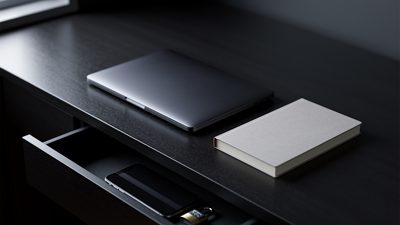
During a deep work block, your phone cannot be in your peripheral vision. Put it in a drawer, or better yet, put it in another room. If you need to be reachable for genuine emergencies, set your phone to "Do Not Disturb" but allow calls from your spouse or your kid's school to bypass the filter. Everything else waits.
2. The Closed Door Rule If you have an office door, close it. An open door is a universal invitation for small talk. If you work in an open-plan office or a shared space, you must create a synthetic door.
Invest in large, over-ear noise-canceling headphones. Do not use subtle earbuds; you want the visual cue to be obvious from across the room. When the headphones are on, you are unreachable.
Phase 2: Neutralize the Digital Threat
Digital interruptions are worse than physical ones because they are infinite. Slack, Microsoft Teams, and email are designed to hijack your dopamine circuitry. You must strip them of their power.
1. Kill the Pings Turn off all desktop notifications. All of them. There is no legitimate reason for a banner to slide across your screen every time an email lands in your inbox.
2. Leverage App Blockers Willpower is a finite resource; do not rely on it. Use software like Freedom or Cold Turkey to physically block your access to distracting websites and desktop apps during your focus block. Make it impossible to fail.
3. Batch Your Communications Stop treating your inbox like a chat room. Process your email and Slack messages in batches. Check them at 9:00 AM, 12:00 PM, and 4:00 PM. The rest of the time, the applications remain closed.
Phase 3: Boundary Scripts for the Workplace
This is where men hesitate. They worry that setting boundaries will make them look uncooperative or lazy. The opposite is true. Professionals respect professionals who guard their time to deliver high-quality results.
Here are the exact scripts you can use to protect your time without burning bridges.
Scenario A: The "Quick Question" Coworker When a peer interrupts you in person or via message with, "Hey, got a second?"
The Script: "I'm in the middle of a deep work sprint on the [Project Name] deliverable right now and need to keep my head down. I'll be coming up for air at 11:30. Let's sync up then—I'll come find you."
Why it works: It asserts your boundary, justifies it with a high-value task, and provides a specific time when you will be available.
Scenario B: The Demanding Boss Bosses want results. If you frame your focus time as the mechanism that delivers those results, they will support it. Have a proactive conversation with your manager, not a reactive one.
The Script: "To make sure I deliver the highest quality work on [Key Project], I'm going to start blocking out 90 minutes every morning for uninterrupted focus. During that time, I won't be checking email or Slack. If there is a true emergency that needs my immediate attention, please call my cell phone. Otherwise, I'll respond to all messages by 11:00 AM. Does that work for you?"
Why it works: You aren't asking for permission to slack off; you are taking ownership of your productivity. You also provide a clear emergency bypass protocol, which alleviates their anxiety about being unable to reach you.
Scenario C: The Status Update Update your Slack or Teams status before you go dark.
The Script: 🔴 Deep Work Block until 11:00 AM. For urgent, time-sensitive emergencies, call my cell.
Phase 4: Boundary Scripts for the Home
Working from home introduces a completely different set of challenges. Spouses, roommates, and children often struggle to separate your physical presence from your actual availability.
You must have a sit-down conversation with the people you live with. Do not do this while you are stressed or in the middle of a workday. Do it on a Sunday afternoon.
Scenario A: The Spouse or Partner The Script: "My work requires intense concentration to get things done efficiently. When I am constantly shifting gears, my work suffers, and I end up working longer hours. Starting tomorrow, when my office door is closed (or when my headphones are on), I need you to treat it like I am physically not in the house. Unless the house is on fire or someone is bleeding, please save all questions and conversations until I come out at lunch. This will help me finish my work faster so I can be fully present with you this evening."
Why it works: It frames the boundary as a benefit to the relationship. You are protecting your work time so you can protect your family time.
Scenario B: The Casual Texter Friends or family members who text you memes or casual questions during your peak work hours.
The Protocol: Do not reply. Not even to say "I'm busy." Any reply reinforces the behavior that you are available to chat. Let the message sit until your workday is over. When you do reply at 6:00 PM, you implicitly train them that daytime texts will not yield daytime responses.
Phase 5: The 90-Minute Focus Protocol
Now that you have cleared the perimeter, you need to execute.
Human biology operates on ultradian rhythms—cycles of roughly 90 to 120 minutes of high energy and focus, followed by a 20-minute dip where the body needs recovery. You cannot force yourself to do deep work for four hours straight.
Here is your daily protocol:
Step 1: Define the Target. Before the block begins, identify the single most important, cognitively demanding task you need to accomplish. Write it on a physical piece of paper and put it on your desk.
Step 2: Deploy the Defenses. Phone out of the room. Apps blocked. Door closed. Headphones on. Status updated.
Step 3: The 90-Minute Sprint. Set a timer for 90 minutes. Start working. When the urge to check email or grab a snack hits you—and it will—look at the timer. You do not stop until the clock hits zero.
Step 4: The 20-Minute Recovery. When the timer goes off, stop immediately. Step away from the screen. Walk outside, drink a glass of water, or stretch. Do not use this recovery time to check social media; scrolling is not rest. Let your brain reset.
The 24-Hour Challenge
Reading about focus changes nothing. Execution is the only metric that matters.
Here is your challenge for tomorrow:
- Look at your calendar right now and block out a 90-minute window for tomorrow morning.
- Send the necessary messages to your boss, team, or family setting the boundary for that specific block.
- Tomorrow, execute the 90-minute protocol relentlessly. No phone, no email, no excuses.
Command your time, or the world will command it for you. The choice is yours.

Daniel Voss
Productivity Strategist
Former tech founder turned productivity strategist. Daniel writes about deep work, digital minimalism, and building systems that amplify output without burning out.
View full profile →