Kill Decision Fatigue: How to Automate Your Morning and Guard Your Cognitive Energy
Stop bleeding cognitive capital on trivial choices. Automate your morning, standardize your routines, and save your decision-making energy for the work that actually moves the needle. Here is the blueprint.
You wake up. The alarm blares.
Do you hit snooze or get up? What are you going to wear today? Should you make eggs or just grab a protein bar? Do you check your email before you shower or after? Which podcast are you listening to on the commute?
By 8:30 AM, you have already made fifty decisions. And here is the brutal truth: not a single one of those decisions made you a dime, improved your physical health, or advanced your mission in life.
You are bleeding cognitive capital on trivial garbage.
If you want to operate at a high level, you have to stop treating your mental energy like an infinite resource. It is not. It is a finite, highly depletable battery. Every time you weigh options, negotiate with yourself, or deliberate over a choice, you drain that battery.
Amateurs waste their cognitive battery on deciding what shirt to wear. Professionals automate the trivial so they can deploy their full mental firepower on the decisions that actually move the needle.
Here is how you eliminate decision fatigue before noon and take back control of your cognitive bandwidth.
The Biology of Decision Fatigue
To understand why you need to automate your morning, you need to understand how your brain works.
The prefrontal cortex is the part of your brain responsible for logical thinking, willpower, and complex decision-making. It is a biological engine, and like any engine, it requires fuel. When you make decisions, you burn through glucose and metabolic resources.
In the late 1990s, social psychologist Roy Baumeister coined the term "ego depletion." His research demonstrated that willpower and decision-making capacity act like a muscle. The more you use it, the more exhausted it gets.
The most famous real-world example of this is the 2011 study of Israeli parole board judges. Researchers analyzed over 1,000 rulings and found a terrifying pattern. First thing in the morning, judges granted parole to roughly 65% of prisoners. But as the morning dragged on and the judges suffered from decision fatigue, the favorable rulings plummeted—hitting nearly 0% right before lunch. After the judges ate and took a break, the approval rate spiked right back up to 65%.
Think about that. The fate of a man's freedom wasn't decided by the details of his crime or his rehabilitation. It was decided by whether the judge had enough cognitive energy left to make a complex, risky decision. When the brain is tired, it defaults to the safest, easiest option (in the judges' case, denying parole; in your case, scrolling social media instead of doing deep work).
If decision fatigue can compromise a highly trained judge, it is absolutely compromising you. You cannot afford to waste your best cognitive hours on mundane choices.
Phase 1: The Pre-Game (Automating the Night Before)
You do not build a successful morning routine in the morning. You build it at 9:00 PM the night before.
If you wake up and have to figure out what you are doing that day, you have already lost. The goal of the evening routine is to eliminate every possible friction point for the following morning.
Standardize the Wardrobe
There is a reason Steve Jobs wore a black turtleneck every day, and why Barack Obama only wore gray or blue suits while in office. They understood that wardrobe selection is a massive waste of cognitive energy.
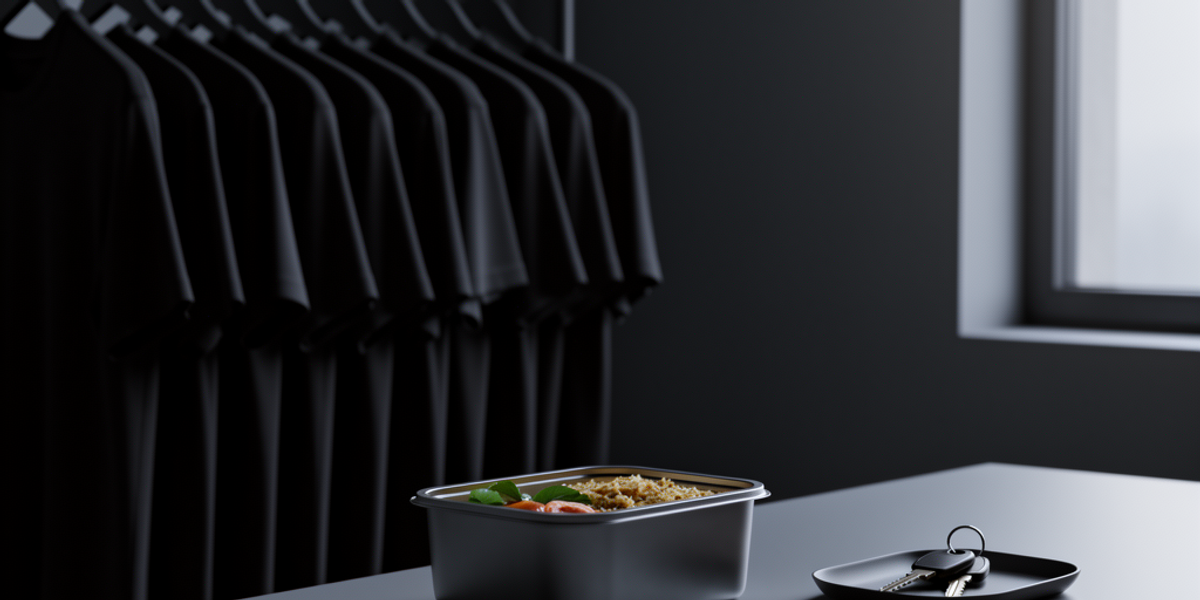
You do not need to wear the exact same shirt every day, but you need a "daily uniform" system. Before your head hits the pillow, your clothes for the next day must be laid out.
If you train in the morning, your gym clothes, socks, and shoes should be sitting at the foot of your bed. If you are going to the office, your suit, shirt, and tie should be hanging on the door. No thinking. You wake up, you put on the fabric in front of you, and you move.
The 3-Target Strike
Never wake up wondering what you need to work on.
Before you end your workday, write down the three most important tasks for tomorrow on a physical piece of paper. Not 10 tasks. Not a sprawling wish list. Three critical, needle-moving targets.
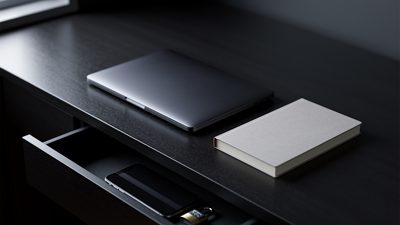
Leave that piece of paper on your desk. When you sit down to work the next morning, your mission is already assigned. You do not need to open your email to figure out what to do. You just execute the list.
Phase 2: The Zero-Friction Morning
The perfect morning routine is not a 14-step ritual involving ice baths, journaling, meditation gongs, and sun-gazing. That is internet self-help fluff.
The perfect morning routine is a scripted, automated sequence of actions that requires zero conscious thought.
The Standardized Fuel Protocol
Food is fuel. Before noon, it is not entertainment. It is not a culinary experience. It is the raw material you need to perform.
Deciding what to eat, scavenging through the fridge, and prepping a complex meal burns time and energy. You have two options for morning nutrition:
- Fasting: The ultimate decision-eliminator. Black coffee, water, and zero calories until noon. This frees up digestion energy and keeps your mind razor-sharp.
- The Default Meal: If you need calories to perform, eat the exact same thing every single day. Four scrambled eggs, spinach, and a piece of fruit. Or a protein shake with oats and peanut butter. Pick a high-protein, low-sugar meal, and lock it in. Buy the ingredients in bulk. Eat it mechanically.
The Digital Quarantine
This is the most critical rule in this entire framework: You do not consume the world's agenda before you have advanced your own.
Your smartphone is a decision-generating machine. When you open an app, you are bombarded with choices: Should I reply to this text? Should I read this article? Should I be angry at this news headline?
Every time you react to a notification, you are letting someone else dictate how you spend your cognitive energy.
Keep your phone on airplane mode or in another room until you have completed your first block of deep work. No email, no social media, no news, no text messages before 10:00 AM. If you think your business will burn down because you were unreachable for two hours in the morning, you have built a fragile business.
Phase 3: Deploying Your Energy (The 90-Minute Sprint)
By automating your clothes, your food, and your schedule, you have successfully preserved your cognitive battery. You are now entering the workday with 100% capacity.
Now, you must deploy that energy ruthlessly.
Eat the Frog
Mark Twain famously said, "If it's your job to eat a frog, it's best to do it first thing in the morning. And if it's your job to eat two frogs, it's best to eat the biggest one first."
Your "frog" is the hardest, most complex, most important task on your 3-Target Strike list. It is the task you usually procrastinate on. It is the proposal, the financial model, the hard conversation, or the strategic planning.
Because you have protected your prefrontal cortex all morning, you have the biological horsepower required to tackle this problem.
Block off 90 minutes. Close your door. Put on noise-canceling headphones. Do not open a single tab on your browser that is not directly related to the task. Attack the problem with violent execution.
Batch the Trivial
What about emails, Slack messages, and administrative forms?
Those are low-leverage tasks. They require very little critical thinking. Push them to the afternoon.
When your cognitive battery is depleted at 2:00 PM, that is the perfect time to reply to emails, approve expenses, and sit in on status meetings. Match the complexity of the task to your biological energy levels. High energy for high-leverage work in the morning. Low energy for administrative maintenance in the afternoon.
The 7-Day Challenge
Reading about productivity is a form of procrastination. Information without execution is useless. If you are serious about upgrading your output, you need to implement this immediately.
I am challenging you to run the Zero-Friction Morning Protocol for the next seven days.
Here are your exact marching orders:
- Tonight at 9:00 PM: Lay out your clothes for tomorrow. Write down your top three targets on a piece of paper. Put your phone on a charger in a different room.
- Tomorrow Morning: Wake up when the alarm goes off—no snooze. Put on the clothes laid out for you.
- Fuel: Drink 16 ounces of water and consume your default breakfast (or fast).
- Execution: Sit down at your desk. Do not check your phone or email. Work for 90 uninterrupted minutes on Target Number One.
Do this for seven days. You will be shocked by how much time you recover, how much anxiety disappears, and how much aggressive momentum you build before the rest of the world has even had their first cup of coffee.
Stop deliberating over the trivial. Automate the baseline. Guard your energy. Go do the work.

Daniel Voss
Productivity Strategist
Former tech founder turned productivity strategist. Daniel writes about deep work, digital minimalism, and building systems that amplify output without burning out.
View full profile →