The Phone Is Your Enemy: A Digital Detox Framework for Men
You spend 60 days a year staring at your phone. It's time to take your life back. Here is a no-BS, tactical framework to cut your screen time in half, reclaim your attention, and stop letting a piece of glass dictate your future.
Average screen time for adults is currently sitting at over four hours a day.
Let's do the math on that. Four hours a day is 28 hours a week. That is 1,456 hours a year. Divide that by 24, and you arrive at a staggering, sickening reality: you are spending 60 full days—two entire months out of every twelve—staring at a glowing rectangle.
If someone told you they were going to lock you in a room for two months every year and force you to watch other people live their lives, you would fight them. You would view them as a tyrant. Yet, you do this to yourself voluntarily. You pay for the privilege.
Your phone is not a neutral device. It is not just a tool. In its current configuration, it is your enemy. It is a highly engineered trap designed by thousands of the smartest engineers and psychologists on the planet to steal your most valuable asset: your attention.
We are not going to talk about throwing your phone in a river and moving to the woods. You have a job, you have a family, and you live in the modern world. You need a phone. But you need it to be a tool again, not a master.
Here is a structured, practical framework to cut your screen time in half without going Amish.
The Economics of Attention
Before you change your habits, you need to change your mindset. You need to understand what is actually happening when you scroll.
Attention is fundamentally a currency. Notice the language we use: we pay attention. And just like money, once it is spent, it is gone forever. You have a finite amount of time on this earth, and a finite amount of cognitive bandwidth each day.
The tech companies know this. Their entire business model is built on harvesting your attention and selling it to advertisers. You are not the customer; you are the product. The infinite scroll, the red notification badges, the variable rewards—these are not design accidents. They are the exact same psychological mechanisms used in casino slot machines.
When your dopamine baseline is constantly hijacked by cheap, digital inputs, you lose the drive to do hard things. Hard things—building a business, lifting heavy weights, cultivating a strong relationship, mastering a skill—require sustained focus. If your brain is wired to expect a hit of dopamine every three seconds from a short-form video, you will physically lack the neurochemical drive to read a book or build a legacy.
You aren't weak; you are just outgunned. But acknowledging the trap is the first step to dismantling it.
Phase 1: The Brutal Audit
You cannot manage what you do not measure. Before you change a single setting, you need to look the beast in the eye.
Open your phone's settings right now. Go to Screen Time (Apple) or Digital Wellbeing (Android). Look at your daily average for the last week. Do not look away. Own the number.
Now, look at the breakdown of where that time went. Categorize your usage into two buckets: Utility and Consumption.
Utility is maps, banking, phone calls, texting your wife, checking your calendar, or responding to a client email. This is the phone acting as a tool.
Consumption is social media, endless news scrolling, YouTube rabbit holes, and browsing forums. This is the phone acting as a parasite.
Your goal is not to eliminate Utility. Your goal is to ruthlessly execute Consumption. If you are clocking four hours a day, I guarantee at least two and a half of those hours are pure consumption. That is the fat we are going to trim.
Phase 2: Tactical Friction
Willpower is a finite resource. If you rely on willpower to stop looking at your phone, you will fail. By 7:00 PM, when you are tired from work, your willpower is depleted, and you will default to the path of least resistance.
The solution is friction. You must engineer your environment so that mindless scrolling becomes difficult and annoying.
Protocol 1: The Notification Execution
Notifications are other people dictating your schedule. They are a tap on the shoulder from a stranger demanding your immediate attention.
Go into your settings and turn off every single notification except for direct human communication.
- Texts? Keep them on.
- Phone calls? Keep them on.
- Calendar alerts? Keep them on.
- Email? Off. Check it on your terms, not when a server decides to push a message.
- News alerts? Off. If World War III starts, I promise someone will tell you.
- Social media? Off. Every single one.
- Sports scores? Off.
Your phone should only vibrate or light up if a flesh-and-blood human being specifically needs you in that exact moment. Everything else can wait until you decide to look.
Protocol 2: The Home Screen Strip-Down
Unlock your phone. What do you see? If your home screen is littered with colorful icons begging to be tapped, you are setting yourself up for failure.
Clear your first home screen completely. The only apps allowed on the first page are pure utility. Maps, Calendar, Camera, Phone, Text Messages, Notes.
Take your browser (Safari/Chrome), your email, and any social media apps you absolutely must keep, and bury them. Put them on the second or third page, hidden inside a folder. Make yourself swipe and search to find them. That two-second delay is often enough friction to make your brain realize, "Wait, I don't actually need to look at this."
Protocol 3: The Grayscale Switch
Your phone screen is engineered to be a candy store for your visual cortex. The colors are hyper-saturated to keep your eyes locked in.
Turn it off. Go to your accessibility settings and turn on Grayscale (Color Filters).
Suddenly, Instagram looks like a 1950s newspaper. YouTube thumbnails lose their pop. The red notification badges turn into dull gray dots. Your phone instantly transforms from an entertainment center into a utilitarian tool. It becomes profoundly boring. This is exactly what you want.
Phase 3: Physical Boundaries
You have optimized the software. Now you must optimize the physical location of the device. The phone should not be an extension of your physical body.
The First and Last Hour Rule
The most destructive thing you can do to your brain is check your phone within the first 60 minutes of waking up. You are immediately throwing your mind into a reactive state, flooding it with cortisol (work emails) or cheap dopamine (social media) before you have even brushed your teeth.
The same applies to the last hour of the day. The blue light destroys your melatonin production, and the content keeps your mind racing when it should be powering down.
The Rule: Your phone does not enter the bedroom. Ever.
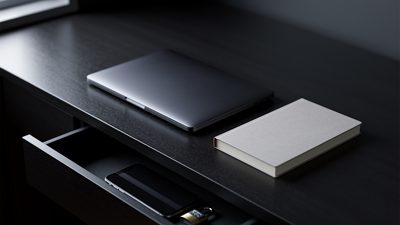
Buy a ten-dollar digital alarm clock. Plug your phone into a charger in the kitchen, the living room, or the home office. When you wake up, you will be forced to get out of bed to turn off the alarm (if you even need one). You now have the first hour of the day to yourself. Read, lift, stretch, drink water, pray, meditate, or just stare at the wall. Reclaim your mornings.
The "Phone Purgatory"
When you are at home, your phone should not be in your pocket. If it is in your pocket, you will instinctively pull it out the second you feel a hint of boredom—waiting for the microwave, walking to the bathroom, sitting on the couch.
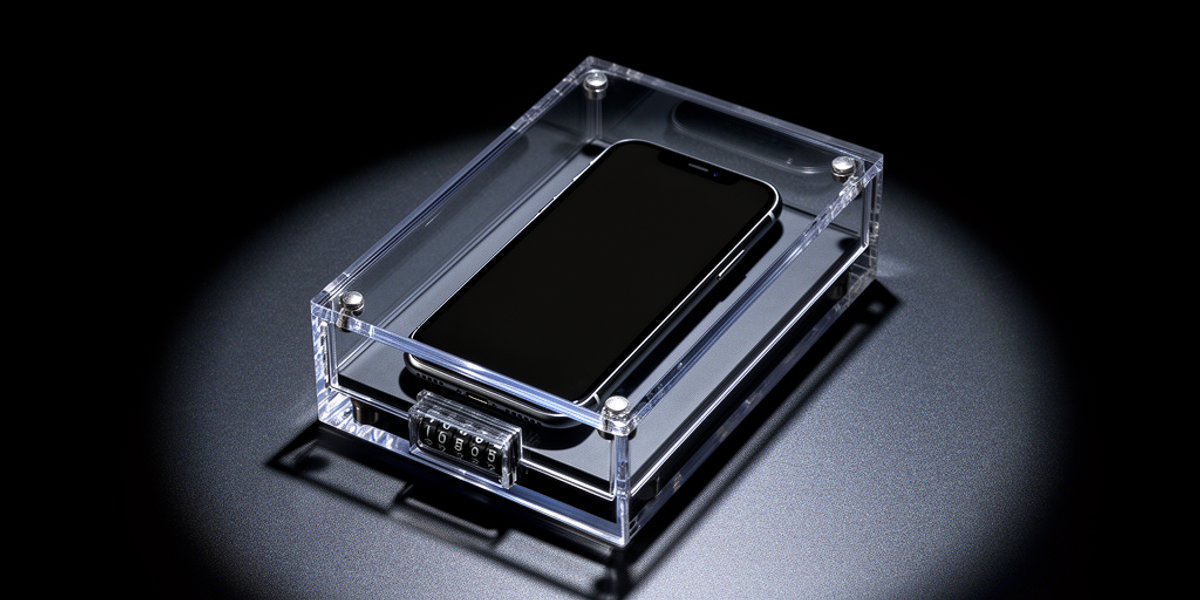
Establish a "Phone Purgatory" in your house. This is a specific spot—a counter, a bowl, a desk—where the phone lives when you are home. If you want to use it, you have to stand there and use it. You will be shocked at how much less you use your phone when you can't take it to the couch with you.
Phase 4: Filling the Void
Nature abhors a vacuum. If you successfully strip away two hours of screen time a day, you are going to feel a massive void. You will experience withdrawal. You will feel twitchy, anxious, and bored.
Embrace the boredom. Boredom is the crucible of creativity and ambition. When you are bored, your brain is forced to generate its own stimulation.
But you must have a plan for that reclaimed time, or you will relapse. Two hours a day is 14 hours a week. What are you going to do with a part-time job's worth of free time?
- Train: You now have time to lift weights, run, or train martial arts. No more "I don't have time to work out" excuses.
- Read: If you read for just 30 minutes of that reclaimed time, you will finish a book every two weeks. That's 26 books a year.
- Build: Start the side business. Fix the things around your house. Organize your finances.
- Connect: Look your wife in the eyes when she speaks to you. Wrestle with your kids without holding a piece of glass in your left hand. Be a physically and mentally present man in your own home.
The Challenge
Reading this article is easy. Nodding along is easy. Execution is hard.
I am not asking you to try this for a year. I am challenging you to try this for seven days.
- Today, right now: Go to settings and turn your screen to grayscale.
- Tonight: Leave your phone in the kitchen when you go to sleep.
- Tomorrow morning: Do not look at a screen for the first hour you are awake.
Take control of your attention. Stop trading your finite time on earth for cheap digital illusions. The world needs strong, focused, capable men—and you cannot be that man if you are spending two months a year staring at your phone.
Put the device down. Get to work.

Daniel Voss
Productivity Strategist
Former tech founder turned productivity strategist. Daniel writes about deep work, digital minimalism, and building systems that amplify output without burning out.
View full profile →