Time Blocking: The Scheduling System That Actually Works
Stop relying on to-do lists that only catalog your anxiety. Time blocking assigns every hour a purpose, forcing you to execute on what matters. Here is the no-BS guide to taking control of your day.
To-do lists are a lie you tell yourself. You write down fifteen tasks, check off the three easiest ones—usually replying to an email or organizing your desk—and feel a false sense of accomplishment. Meanwhile, the actual needle-moving work, the hard stuff that requires focus and discipline, rots at the bottom of the page.
You aren't managing your time; you are just cataloging your anxiety.
If you are serious about building a business, transforming your physique, or mastering a complex skill, you need a system that reflects reality. A to-do list assumes you have infinite time to complete infinite tasks. You don't. You have 24 hours. You need a system that forces you to confront the brutal math of a limited day.
That system is time blocking.
Time blocking is the practice of planning out every moment of your day in advance and dedicating specific time "blocks" for certain tasks and responsibilities. It shifts your operating question from "What should I do next?" to "What does the calendar say I am doing right now?"
Here is exactly why your current system is failing, the science behind why time blocking works, and the specific protocols you need to implement today to take ownership of your schedule.
Why Your To-Do List is a Trap
To-do lists lack context, priority, and boundaries. A list item that says "write quarterly report" looks exactly the same as "reply to John's email." But one takes three hours of intense cognitive effort, and the other takes three minutes of mindless typing.
When you operate off a list, you fall victim to three specific psychological traps:
1. Parkinson's Law: This law states that "work expands to fill the time available for its completion." If you give yourself all day to write a proposal, it will take all day. Without hard boundaries, tasks bleed into your personal time, ruining your evening and destroying your recovery.
2. Decision Fatigue: Every time you finish a task on a to-do list, you have to look at the remaining items and decide what to do next. That friction drains your willpower. By 2:00 PM, your brain is exhausted from making choices, so you default to the path of least resistance: scrolling your phone or checking Slack.
3. The Zeigarnik Effect: This is a psychological principle dictating that people remember uncompleted or interrupted tasks better than completed tasks. A massive to-do list creates background anxiety because your brain is trying to keep track of everything you haven't done.
Time blocking destroys all three of these traps. It creates artificial deadlines to beat Parkinson's Law. It eliminates decision fatigue because the decision was already made the night before. And it quiets the Zeigarnik effect because your brain knows there is a dedicated time slot to handle that specific task later.
The Cognitive Science of Constraint
This isn't just productivity dogma; it is backed by cognitive science. The American Psychological Association has published extensive research on the costs of "context switching." Every time you shift your attention from a deep task to a shallow task (like checking your phone) and back again, you pay a "switching penalty."
Research shows that shifting between tasks can cost you up to 40% of your productive time. Read that again. You are throwing away nearly half of your output because you refuse to focus on one thing at a time.
Furthermore, human biology operates on Ultradian Rhythms—cycles of brain activity that last roughly 90 to 120 minutes, followed by a necessary period of rest. Time blocking allows you to structure your day in alignment with your biology. You block 90 minutes of aggressive, uninterrupted focus, followed by 20 minutes of recovery. You stop fighting your physiology and start leveraging it.
The 5 Protocols of Unbreakable Scheduling
If you want to implement time blocking effectively, you cannot just throw a few random tasks onto Google Calendar and hope for the best. You need a structured approach. Follow these five protocols.
Protocol 1: The Non-Negotiable Anchors
Your day does not start with work. It starts with the baseline requirements for a high-performing human being. Before you schedule a single meeting or work task, you block out your non-negotiables.
Schedule your sleep (aim for 7-8 hours). Schedule your training. Schedule your meals. If you don't put your gym session on the calendar, it will get pushed aside the second a "work emergency" pops up. Treat your physical training and recovery blocks with the exact same respect you would give a meeting with your biggest client. You wouldn't cancel on them; don't cancel on yourself.
Protocol 2: The Deep Work Blocks
Coined by computer science professor Cal Newport, "Deep Work" is the ability to focus without distraction on a cognitively demanding task. This is where you actually make your money. This is where you build the business, write the code, or design the strategy.
You need to schedule one to two Deep Work blocks per day, lasting 90 to 120 minutes each. Place these blocks during your biological peak. For most men, this is first thing in the morning. During a Deep Work block, your phone is in another room. Your email is closed. Your door is shut. You are doing one thing, and one thing only.
Protocol 3: Reactive and Admin Batching
Emails, Slack messages, phone calls, and administrative paperwork are the death of deep focus. However, they still need to get done. The solution is batching.
Instead of checking your email 50 times a day, schedule two 45-minute "Admin Blocks"—one at 11:30 AM and one at 4:00 PM. During these blocks, you attack your inbox with ruthless efficiency. When the block is over, you close the inbox. If someone needs you urgently, they will call you. Stop letting other people's priorities dictate your schedule.
Protocol 4: Buffer Zones
You are not a machine, and life is inherently chaotic. Meetings run long. Traffic backs up. Software crashes. If you schedule every minute of your day back-to-back, a single five-minute delay will cause a domino effect that ruins your entire afternoon.
Build "Buffer Zones" into your calendar. Schedule 15 to 30 minutes of blank space between major transitions. Use this time to use the bathroom, get water, stretch, or absorb the overflow from a task that took longer than expected.
Protocol 5: The Daily Shutdown
The most critical block of your day is the last one. Schedule 15 to 20 minutes at the end of your workday for a "Shutdown Routine."
During this block, you review what you accomplished, migrate any unfinished tasks, and most importantly, time block your schedule for tomorrow. You never wake up wondering what you need to do. The plan is already set. You just wake up and execute.
How to Build Your First Time-Blocked Calendar TODAY
Theory is useless without execution. Here is exactly how you are going to build your schedule for tomorrow.
Step 1: Choose Your Tool Keep it simple. Google Calendar or Apple Calendar are ideal because you can easily click, drag, and adjust blocks. If you prefer analog, buy a physical daily planner with hour-by-hour slots. Do not overcomplicate the software.
Step 2: Map the Canvas Look at tomorrow's 24-hour canvas. Block out your sleep first. If you want to wake up at 5:00 AM, block out sleep from 9:30 PM to 5:00 AM.
Step 3: Lock in the Anchors Block out 5:00 AM to 6:30 AM for the gym and a shower. Block out your commute. Block out 30 minutes for lunch.
Step 4: Place the Needle-Mover Identify the single most important task for tomorrow. What is the one thing that will actually move your life or business forward? Block out 90 to 120 minutes for it. Let's say 8:00 AM to 10:00 AM. Label it clearly: "DEEP WORK: Q3 Strategy Deck."
Step 5: Box out the Admin and Meetings Drop your pre-scheduled meetings into the calendar. Then, assign your batching blocks. Put an "Email/Admin" block from 11:30 AM to 12:00 PM, and another from 4:00 PM to 4:45 PM.
Step 6: Add Buffers and Shutdown Fill in the gaps. Add 15-minute buffers after long meetings. Finally, schedule your 15-minute Daily Shutdown at 4:45 PM.
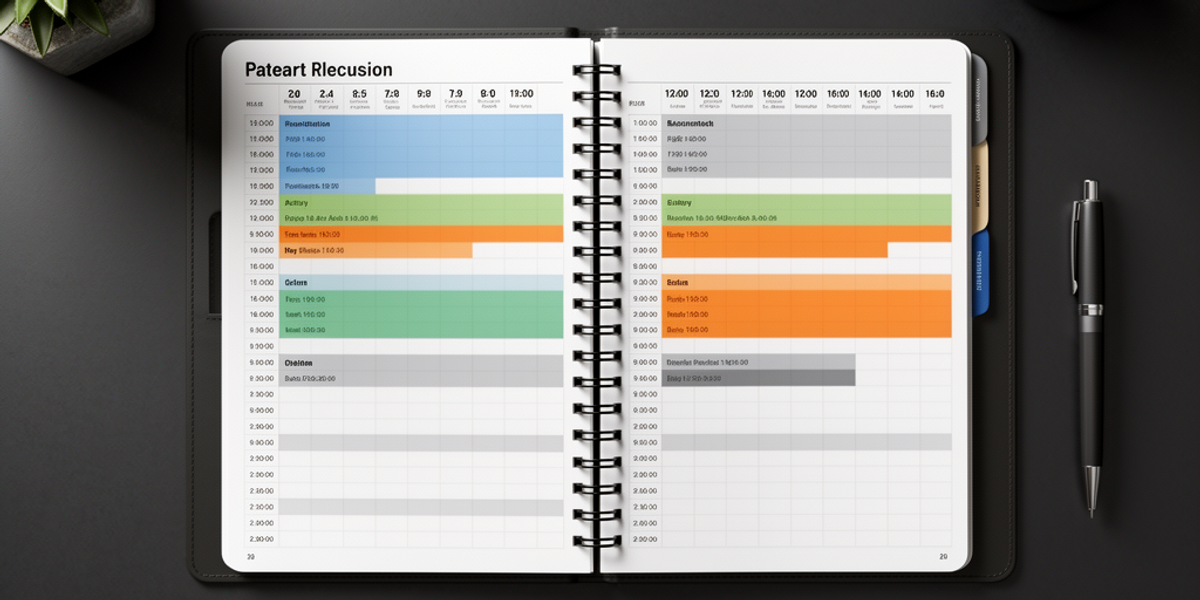
Here is what a highly effective, time-blocked day looks like in practice:
- 05:00 - 06:30: Training & Shower
- 06:30 - 07:30: Breakfast, Read, Commute
- 07:30 - 08:00: Buffer / Daily Prep
- 08:00 - 10:00: Deep Work Block (High-leverage project)
- 10:00 - 10:30: Buffer / Break
- 10:30 - 11:30: Meeting / Collaborative Work
- 11:30 - 12:00: Admin / Email Batching
- 12:00 - 13:00: Lunch & Walk
- 13:00 - 14:30: Deep Work Block 2 or Secondary Projects
- 14:30 - 15:00: Buffer / Break
- 15:00 - 16:00: Calls / Meetings
- 16:00 - 16:45: Final Admin / Inbox to Zero
- 16:45 - 17:00: Daily Shutdown & Plan Tomorrow
- 17:00 Onward: Disconnect / Family / Personal Time
Troubleshooting: When the Plan Goes to Hell
You will inevitably have days where a crisis blows up your calendar. A client threatens to leave, a pipe bursts in your house, or your kid gets sick.
Amateurs use these moments as an excuse to abandon the system entirely. "Well, the morning is ruined, might as well wing the rest of the day."
Professionals adapt. Your calendar is a living document, not a prison sentence. When a crisis hits, you handle the crisis. But the moment the fire is put out, you open your calendar, look at the time remaining in the day, and adjust the remaining blocks. You shift the Deep Work block to the afternoon, or you delete a low-priority admin block to make room. You re-establish control immediately.
The Challenge
Reading about productivity is just another form of procrastination. It's time to do the work.
Your challenge is simple: Tonight, before your head hits the pillow, open your calendar. Block out every single hour for tomorrow. Sleep, training, deep work, admin, and rest.
Tomorrow, do not look at a to-do list. Do not wonder what you should be doing. Just look at the calendar and obey the blocks you set for yourself. Stop leaving your success up to how you "feel" in the moment, and start engineering your days for execution. Take control of your time, or someone else will.

Daniel Voss
Productivity Strategist
Former tech founder turned productivity strategist. Daniel writes about deep work, digital minimalism, and building systems that amplify output without burning out.
View full profile →