Cold Plunge vs Cold Shower: What Actually Works for Recovery
Stop wasting money on hype. Here is the science-backed breakdown of cold showers vs. cold plunges, exact temperature thresholds, and how to use cold exposure to accelerate recovery without killing your gains.
The Hype vs. The Reality
You’ve seen the videos. Every fitness influencer, CEO, and self-proclaimed biohacker on your feed is sitting in a $5,000 tub of ice water, staring into the camera like they’ve just unlocked the secrets of the universe. They preach about cold exposure like it’s a magic bullet for everything from muscle soreness to financial success.
Let’s cut through the noise.
Cold exposure is not magic, but it is a highly effective physiological tool. When used correctly, it accelerates recovery, builds mental resilience, and shifts your neurochemistry in ways that caffeine can only dream of. When used incorrectly, it wastes your time, drains your wallet, and can actually destroy the muscle gains you just spent an hour in the gym fighting for.
You don't need a hype man telling you to "embrace the suck." You need to understand the mechanics of your own body. If you are serious about optimizing your recovery, you need to know the difference between a cold shower and a full submersion plunge, what temperatures actually trigger adaptation, and precisely when to use them.
Here is the unvarnished truth about cold exposure, backed by science, stripped of the marketing BS.
The Physiology of the Freeze
To understand what works, you need to understand what happens when you expose your body to extreme cold. You are triggering a survival mechanism.
The Vascular Response
The moment cold hits your skin, your peripheral blood vessels constrict. This is vasoconstriction. Your body is forcefully pulling blood away from your extremities and pushing it toward your core to protect your vital organs. When you get out of the cold and warm up, those vessels dilate (vasodilation), flushing your muscles with fresh, highly oxygenated blood. This pumping action helps clear metabolic waste products like lactic acid and reduces systemic inflammation.
The Neurochemical Spike
Cold exposure causes a massive, prolonged release of neurotransmitters. Research shows that submersion in cold water can increase dopamine levels by up to 250% and norepinephrine by 530%. Unlike the cheap, fleeting dopamine hit you get from scrolling social media or eating junk food, this elevation lasts for hours. It sharpens your focus, elevates your mood, and creates a state of calm alertness.
The Mental Rep
Neuroscientist Andrew Huberman refers to this as "limbic friction." It is the internal resistance you feel when you know you have to do something hard, like stepping into freezing water. Every time you override that instinct and step into the cold anyway, you are training your prefrontal cortex to govern your impulsive, comfort-seeking brain. You are building discipline in real-time.
Cold Showers: The Entry-Level Stimulus
Let’s start with the most accessible option: turning the dial to cold at the end of your morning shower.
What It Does Well
Cold showers are a fantastic primer for your day. They are free, require zero setup, and will absolutely trigger that neurochemical spike in dopamine and norepinephrine. If your goal is simply to wake up, build some daily grit, and shake off a sluggish morning, a 3-minute cold shower is highly effective.
Where It Falls Short
If your goal is deep physiological recovery, a cold shower won't cut it. Here is why:
- Temperature Limits: Most residential tap water in the summer only gets down to about 60-65°F (15-18°C). Even in the winter, it rarely drops below 55°F. This is cool, but it’s not the sharp, systemic shock required for deep adaptation.
- Lack of Hydrostatic Pressure: This is the critical difference. When you submerge yourself in a tub, the water exerts physical pressure on your entire body. This hydrostatic pressure acts like a full-body compression garment, actively assisting in the flushing of fluids and reduction of edema (swelling) in your muscles. A shower does not provide this.
- Uneven Cooling: Water has a thermal conductivity 24 times greater than air. But in a shower, the water is only hitting one side of your body at a time. Your core temperature simply does not drop fast enough or evenly enough to trigger the same level of anti-inflammatory response as submersion.
The Verdict on Showers: Use them for mental toughness and a morning energy boost. Do not rely on them to recover from a brutal leg day or a 10-mile run.
Cold Plunges (Ice Baths): The Heavy Artillery
Full submersion in cold water is where the serious recovery benefits live. This means getting in a tub, barrel, or natural body of water up to your neck.
The Submersion Advantage
When you plunge, the thermal conductivity of the water violently strips heat away from your entire body simultaneously. Combined with hydrostatic pressure, this creates a profound anti-inflammatory effect. Studies on athletes show that cold water immersion significantly reduces Delayed Onset Muscle Soreness (DOMS) and lowers the perception of fatigue.
Do You Need a $5,000 Tub?
Absolutely not. The fitness industry wants you to believe that you need a sleek, Wi-Fi-enabled, self-cooling tub with a luxury logo on the side. You don't. The water doesn't know how much you paid for the container.
Here are your options, ranked by practicality:
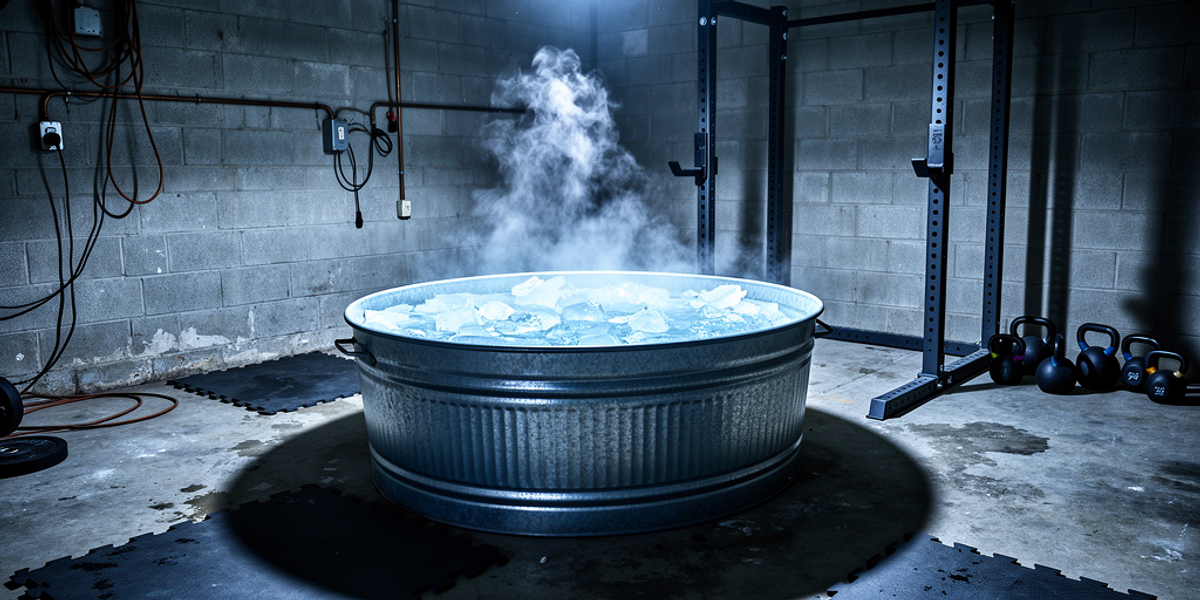
- The Stock Tank (Cost: $100 - $150): Go to a farm supply store, buy a 100-gallon galvanized steel or plastic stock tank. Fill it with a hose. Dump in 40-60 pounds of ice from the gas station when you want to plunge. It’s cheap, brutal, and highly effective. The downside? Buying ice gets annoying and expensive over time.
- The Chest Freezer Conversion (Cost: $300 - $600): This is the ultimate biohacker DIY. Buy a used chest freezer, seal the seams with marine-grade silicone, fill it with water, and plug it into a temperature-control outlet to keep it at exactly 45°F. It requires some weekend labor, but it gives you a premium experience for a fraction of the cost.
- The Commercial Chiller Tub (Cost: $1,000 - $5,000+): If you have the disposable income and value your time over your money, buy one. They are convenient, clean, and always ready. Just know you are paying for convenience, not superior physiological results.
The Timing Trap: Don't Kill Your Gains
This is the most critical section of this article. If you take nothing else away, remember this: Timing your cold exposure incorrectly will actively sabotage your muscle growth.
When you lift weights, you are purposefully causing micro-tears in your muscle fibers. This creates acute local inflammation. Your body responds to this inflammation by sending macrophages and satellite cells to the area to repair the tissue, making it bigger and stronger. This is the mTOR pathway—the primary driver of muscle hypertrophy.
Inflammation is the signal that tells your body to grow.
If you jump into an ice bath immediately after a heavy hypertrophy session, you forcefully shut down that inflammation. You are essentially putting out the fire before the fire department (your immune system) gets the signal to rebuild the house. Research has consistently shown that cold water immersion immediately post-resistance training blunts muscle hypertrophy and strength adaptations.
The Rules of Timing
- For Muscle Growth (Hypertrophy/Strength): Do your cold plunge BEFORE you lift. If you must do it after, wait a bare minimum of 4 to 6 hours. Better yet, save the cold plunge for your rest days to aid in systemic recovery without interfering with the acute inflammatory signal of your workout.
- For Endurance Training (Cardio/Running/Fighting): If your primary goal is cardiovascular endurance, flushing lactic acid, or recovering for another skill session later in the day, plunge immediately after your workout. Endurance adaptations are not blunted by cold exposure the way hypertrophy is.
- For Mental Health and Alertness: Do it first thing in the morning. The dopamine spike will carry you through the first half of your day.
The Protocol: How to Build Your Routine
Stop guessing. Here is the exact framework for cold exposure, based on the research of Dr. Susanna Søeberg, a leading researcher in cold and heat therapy.
The Minimum Effective Dose
You do not need to sit in ice water for 20 minutes to prove how tough you are. In fact, staying in too long can lead to hypothermia and tissue damage.
The magic number is 11 minutes per week.
That is your total cumulative time. You can break this down into three or four sessions of 2 to 3 minutes each. Once you hit the 11-minute mark for the week, you have achieved the vast majority of the metabolic and neurochemical benefits.
The Temperature Threshold
How cold does it need to be? The rule of thumb is that it should be cold enough that you immediately want to get out, but not so cold that you cannot safely control your breathing.
For most men, this falls between 39°F and 50°F (4°C to 10°C).
If you are a beginner, start at 55°F. As you build a tolerance, drop the temperature. The goal is to induce a shock, not to freeze yourself solid.
The Execution
- Get In Fast: Don't dip your toe. Don't wade in slowly. Step in and submerge up to your neck immediately. The hesitation is where you lose the mental battle.
- Control Your Breath: The moment you hit the water, your body will gasp. This is the autonomic nervous system panicking. Your only job for the first 30 seconds is to take slow, deliberate, deep breaths. Box breathing (4 seconds in, 4 seconds hold, 4 seconds out, 4 seconds hold) works perfectly here. Master your breath, and you master your stress response.
- End on Cold: When you get out, do not immediately jump into a hot shower or wrap yourself in a heated blanket. Let your body warm itself up naturally. This forces your body to activate Brown Adipose Tissue (brown fat), which burns calories to generate heat (thermogenesis). Shivering is a good thing; it is your body doing its job.
The Challenge
Reading about cold exposure does nothing for your recovery. Information without execution is just entertainment.
Here is your challenge for today.
If you have access to a cold plunge, schedule your 3-minute session right now. If you don't, you are starting with the shower. Tomorrow morning, at the end of your regular shower, turn the dial all the way to cold. No lukewarm transition. All the way cold.
Stand there for 60 seconds. Control your breathing. Look straight ahead. Don't flinch.
You are going to realize two things very quickly. First, it sucks exactly as much as you thought it would. Second, you are entirely capable of handling it.
Stop pampering your nervous system. Get in the cold.

Jake Novak
Strength Coach & Performance Specialist
Certified strength and conditioning coach with 12 years of experience training athletes and everyday men. Jake focuses on functional strength that translates to real life.
View full profile →