Mobility Is Not Optional: The 10-Minute Routine Every Man Needs
You lift heavy and hustle hard, but if you can't touch your toes or squat without pain, your strength is a liability. Here is the no-BS, 10-minute daily mobility protocol to fix desk-job posture, prevent injuries, and bulletproof your joints.
Most men treat mobility work the way a teenager treats saving for retirement: a problem for another day. You hit the iron, you push your cardio, and you spend eight to ten hours a day folded into a chair staring at a screen. You ignore the slight pinch in your shoulder during overhead presses. You ignore the stiffness in your lower back when you get out of bed.
Then, one day, you bend over to pick up a dropped pen, and your lumbar spine locks up.
Strength without range of motion is a liability. If you can deadlift 400 pounds but cannot tie your own shoes without groaning, you are not truly fit. You have built a massive engine inside a chassis that is rusting apart.
Mobility is not yoga for housewives. It is the fundamental prerequisite for human performance. It is the armor that protects your joints, the foundation that allows you to express your strength, and the antidote to the physical decay caused by modern life.
Here is the truth: your desk job is destroying your body. But you can fix it. This guide outlines the exact, no-BS, 10-minute daily mobility protocol you need to undo the damage, prevent injury, and optimize your physical output.
The Silent Killer of Athleticism: The Chair
To understand why mobility is mandatory, you have to understand what sitting does to your anatomy.
The human body is an adaptation machine. It conforms to the positions it spends the most time in. This is a physiological process known as "adaptive shortening." When you sit at a desk for eight hours a day, your body assumes you want to be shaped like a chair.
Here is what happens mechanically:
- Your hip flexors shorten and tighten. Because your hips are locked in a 90-degree angle, the muscles on the front of your pelvis literally shrink. When you stand up, these tight flexors pull your pelvis forward (anterior pelvic tilt), compressing your lower back.
- Your glutes forget how to fire. Sitting stretches your glutes out and puts them to sleep—a phenomenon Dr. Stuart McGill refers to as "gluteal amnesia." Weak glutes mean your lower back and hamstrings have to overcompensate during every movement.
- Your shoulders internally rotate. Reaching for a keyboard rounds your upper back. Your pectoral muscles tighten, your latissimus dorsi stiffen, and the muscles between your shoulder blades become weak and overstretched. This leads to the classic "caveman posture."
If you take this compromised, stiff, misaligned body into the gym and load it with heavy weights, you are begging for a catastrophic injury. You cannot out-train eight hours of sitting with one hour of lifting. You have to actively reverse the damage.
Flexibility vs. Mobility: Know the Difference
Before we get to the protocol, we need to clear up a common misconception. Flexibility and mobility are not the same thing.
Flexibility is passive range of motion. It is how far a muscle can be stretched by an external force. Think of a martial artist having their legs pushed into the splits by a partner.
Mobility is active, usable range of motion. It is how far you can move a joint through its full range using your own muscular control.
Flexibility without strength is useless and often dangerous. Being able to passively force your shoulder behind your head means nothing if you cannot actively control a barbell in that same position. The protocol below is not about turning you into a gymnast. It is about building strong, controlled, usable mobility so you can move through life and the gym without restriction.
The 10-Minute Daily Mobility Protocol
This is not a random assortment of stretches. This is a targeted, systematic flow designed specifically to attack the areas destroyed by modern life: the ankles, the hips, the thoracic spine, and the shoulders.
Do this every single day. It takes 10 minutes. You can do it first thing in the morning to wake up your nervous system, as a dynamic warm-up before you lift, or in the evening while you wind down. Consistency is infinitely more important than intensity.
Movement 1: The Deep Squat Hold (2 Minutes)
The Target: Ankle dorsiflexion, hip opening, and lower back decompression. The Problem It Fixes: Inability to squat below parallel; tight calves from stiff shoes.
How to do it: Set your feet shoulder-width apart. Root your big toe, little toe, and heel firmly into the ground. Drop your hips back and down into the deepest squat you can manage.
If your heels come off the floor, hold onto a doorframe, a squat rack, or a heavy piece of furniture to counterbalance yourself, allowing you to sit back onto your heels. Keep your chest tall. Do not let your upper back round excessively.
Once in the bottom position, place your elbows inside your knees. Gently press your knees outward to open your groin. Breathe deeply into your belly. With every exhale, try to sink one millimeter deeper into the stretch.
Hold this position for 2 full minutes. It will be uncomfortable. Breathe through it.
Movement 2: The 90/90 Hip Transition (2 Minutes)
The Target: Internal and external hip rotation. The Problem It Fixes: Stiff hip capsules that cause lower back pain and prevent fluid movement.
How to do it: Sit on the floor. Bend your lead leg to 90 degrees directly in front of you (shin parallel to your chest). Bend your trail leg to 90 degrees out to the side. Your legs should form a pinwheel shape.
Sit as tall as possible. To stretch the front hip (external rotation), hinge forward at the waist, keeping your chest proud. Do not round your back. Hold for 5 seconds.
Now, sit back up. Keeping your heels on the floor, slowly windshield-wiper your knees up and over to the other side, so your trail leg now becomes your lead leg.
Alternate sides slowly and with control for 2 minutes. If you cannot do this without using your hands for support behind you, use them—but the long-term goal is to transition smoothly using only your hip strength.
Movement 3: The World's Greatest Stretch (2 Minutes)
The Target: Thoracic spine (mid-back) rotation, hip flexors, and hamstrings. The Problem It Fixes: Upper body stiffness and locked-up hips; the ultimate desk-jockey antidote.
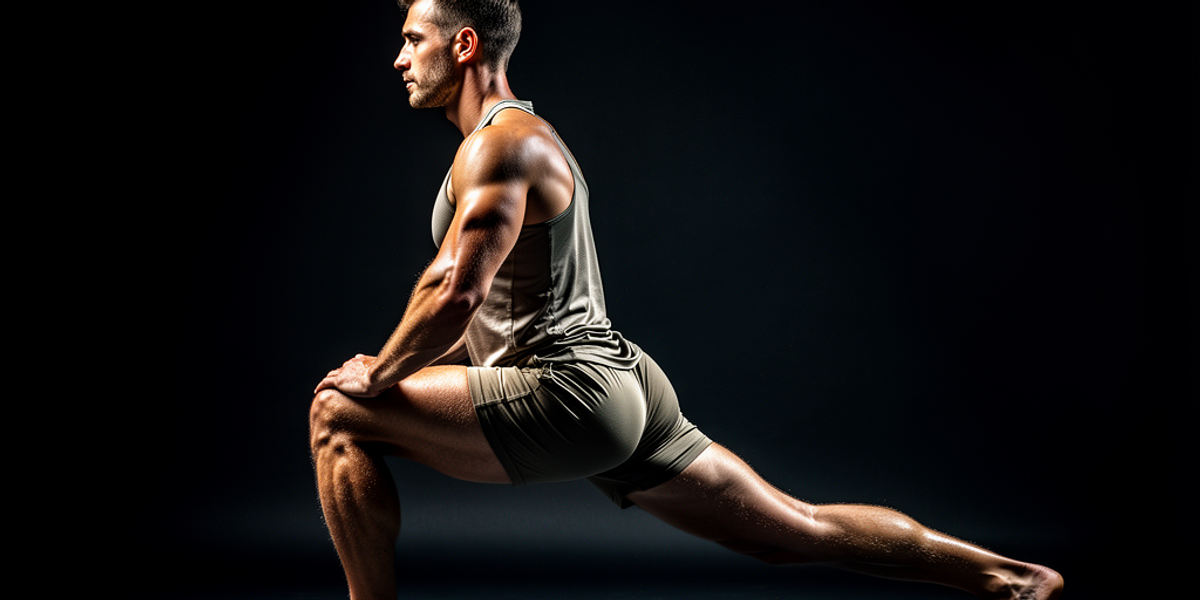
How to do it: Start in a push-up position. Step your right foot up and place it flat on the floor outside your right hand. You are now in a deep runner's lunge. Squeeze the glute of your straight left leg to maximize the stretch in that hip flexor.
Take your right elbow and try to drop it down to the floor inside your right foot. You will feel an intense stretch in your right hamstring and groin.
From that bottom position, rotate your torso and reach your right arm straight up toward the ceiling. Follow your hand with your eyes. Reach as high as you can, opening up your chest and mid-back.
Bring the hand back down, step the right foot back to the push-up position, and repeat on the left side.
Alternate sides for 2 minutes. Move deliberately. Spend 3-5 seconds in the rotated position on each rep.
Movement 4: The Couch Stretch (2 Minutes)
The Target: Quadriceps and deep hip flexors (psoas). The Problem It Fixes: Anterior pelvic tilt and the resulting lower back pain from sitting.
How to do it: You need a wall, a bench, or a couch for this. Kneel facing away from the wall. Slide your right knee all the way back into the corner where the floor meets the wall, so your shin is vertical against the wall and your right foot is pointing up.
Step your left foot out in front of you into a lunge position.
Now, the hard part: bring your torso completely upright. Your goal is to get your glutes touching your right heel, with your chest tall and your ribcage pulled down.
If you sit at a desk all day, this will feel like your thigh is tearing apart. Do not arch your lower back to escape the tension. Squeeze your right glute as hard as you can—this neurologically forces the hip flexor on the front to relax.
Hold for 1 minute on the right leg, then switch and hold for 1 minute on the left leg.
Movement 5: Scapular Wall Slides (2 Minutes)
The Target: Thoracic extension, shoulder mobility, and scapular stability. The Problem It Fixes: Rounded shoulders, forward head posture, and poor overhead pressing mechanics.
How to do it: Stand with your back flat against a wall. Your heels, your glutes, your upper back, and your head must all be touching the wall.
Bring your arms up into a "stick 'em up" position (elbows bent at 90 degrees). The backs of your forearms, wrists, and hands must be touching the wall.
Without letting your lower back arch away from the wall, slowly slide your hands up the wall into a Y-shape. Keep your forearms and hands in contact with the wall the entire time.
Once you reach the highest point you can manage without your lower back arching or your hands coming off the wall, actively pull your elbows back down to the starting position, squeezing your shoulder blades together.
Perform slow, controlled repetitions for 2 minutes. Do not rush this. The burn between your shoulder blades means it is working.
The ROI: Why This Makes You Better
If you dedicate 10 minutes a day to this protocol, the return on investment will be massive.
First, you will become stronger. Muscle grows best when it is loaded through a full range of motion. If tight ankles are stopping you from squatting deep, your leg development is being compromised. Open the ankles, deepen the squat, build bigger legs.
Second, your pain will disappear. Most lower back pain is not a lower back problem; it is a hip mobility problem. When your hips cannot move freely, your lumbar spine is forced to bend and twist to pick up the slack. The lumbar spine is built for stability, not mobility. Unlock your hips, and you save your lower back.
Third, you will look better. Forward head posture and rounded shoulders project weakness, fatigue, and low confidence. Opening your thoracic spine and stretching your chest allows you to stand an inch taller. Good posture is the easiest, fastest way to improve your physical presence.
The 30-Day Challenge
Information without execution is useless. You now know exactly why mobility is critical, and you have the exact protocol to fix your body. The only missing variable is your discipline.
Here is your challenge: Do this 10-minute flow every single day for the next 30 days.
Do not negotiate with yourself. Do not tell yourself you will do it tomorrow. Ten minutes is less time than you spend scrolling on your phone on the toilet. Set an alarm, get on the floor, and do the work.
Pay attention to how your joints feel on Day 1 versus Day 30. Watch how your lifts improve. Notice how the chronic tightness in your lower back fades away.
Mobility is not optional. It is the price you pay to live a highly functional, pain-free life. Pay the toll today, or pay the surgeon tomorrow. Get to work.

Jake Novak
Strength Coach & Performance Specialist
Certified strength and conditioning coach with 12 years of experience training athletes and everyday men. Jake focuses on functional strength that translates to real life.
View full profile →